
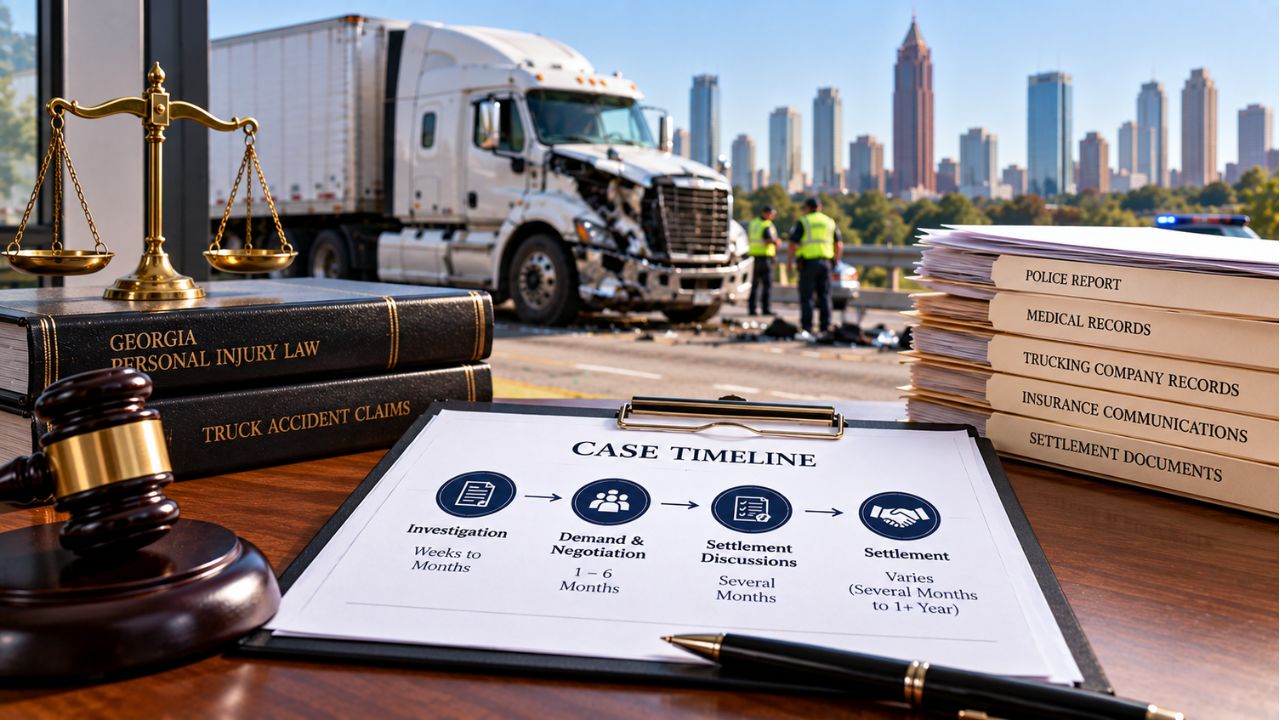
If a commercial truck hit you, one question comes up in almost every first call: how long does a truck accident case take to settle in Georgia? There is no single answer. The timeline depends on your injuries, how clear the liability is, and how much evidence must be gathered before an insurer will pay a fair amount.
Most truck accident claims in Georgia settle within six months to two years. Cases with catastrophic injuries, disputed fault, or multiple defendants often take longer. Below, we walk through the real stages of a truck accident claim and the factors that speed things up or slow them down.
The Typical Timeline for a Georgia Truck Accident Case
Medical Treatment and Early Investigation: 1 to 3 Months
The first month’s focus on medical care and evidence collection. Your treatment record matters because settling before you reach maximum medical improvement usually means settling for less than your case is worth.
Sending Spoliation Letters and Gathering Records: 1 to 4 Months
Trucking companies and their insurers do not keep records forever. A spoliation letter is a formal notice demanding that the carrier preserve evidence, including dispatch logs, driver qualification files, and maintenance records, before they can be routinely deleted or overwritten.
Demand and Negotiation: 2 to 6 Months
Once treatment is complete and evidence is secured, we send a demand package to the carrier’s insurer. Negotiation can move quickly if liability is clear, or drag on for months if the insurer disputes fault or damages.
Litigation, If Necessary: 6 Months to 2 Years
If negotiations stall, filing suit can push the timeline further out, but it often puts real pressure on an insurer to negotiate seriously rather than lowball the claim. Discovery in a truck case often includes driver and safety manager depositions and FMCSA inspection requests, and many cases settle once that evidence is on the table.
Factors Affecting How Long a Truck Accident Case Takes to Settle in Georgia
Several factors decide how long a truck accident case takes to settle in Georgia, and most of them come down to how much digging the case requires before a fair value is clear.
FMCSA Regulations and Hours-of-Service Violations
Federal Motor Carrier Safety Administration rules limit property-carrying drivers to 11 hours of driving after 10 consecutive hours off duty, inside a 14-hour on-duty window, with mandatory breaks and weekly caps. An hours-of-service violation can take weeks to confirm through electronic logging device data, but it often becomes powerful evidence of driver fatigue and carrier negligence.
Black Box and ECM Data
Most commercial trucks carry an electronic control module, often called a black box, that records speed, braking, and engine data in the moments before a crash. Downloading and analyzing this data takes time and usually requires an accident reconstruction expert, which extends the investigation phase but strengthens the case.
Carrier Insurance Layers
Federal commercial truck insurance minimums set a floor for coverage, but claims involving multiple insurance layers, excess policies, or hazmat coverage typically take longer to resolve.
High-Traffic Corridors Like I-285
Accidents on busy Atlanta corridors such as I-285 often involve multiple vehicles, conflicting witness accounts, and heavier property damage, all of which add time to the investigation before a settlement figure can be reached.
Factors Affecting Truck Settlement Value
Settlement timing and factors Affecting Truck Settlement Value are closely connected. Serious injuries, clear liability, strong black box and ELD evidence, and complete documentation of lost wages and future medical expenses can significantly increase a settlement’s value. However, gathering and verifying this evidence takes time. Building a well-supported claim before presenting a demand helps maximize compensation and strengthens your position during settlement negotiations.
Truck Accident vs. Car Accident Claim Difference
A key truck accident vs. car accident claim difference is the number of parties involved. A car accident claim usually involves one driver and one insurer. A truck accident claim can involve the driver, the trucking company, a leasing company, a cargo loader, and a maintenance contractor, each with separate insurance and separate lawyers, which is a major reason truck cases generally take longer to resolve than typical car accident claims.
Truck cases also bring federal regulation into play that car accident claims never do. FMCSA inspection reports, qualification files, and hours-of-service logs simply do not exist in a car accident claim, and reviewing them adds real time to a truck case.
Georgia Law You Should Know
Statute of Limitations
Under O.C.G.A. § 9-3-33, most Georgia personal injury claims, including truck accident claims, must be filed within 2 years of the crash. Missing this deadline generally bars recovery entirely, regardless of how strong the evidence is.
Modified Comparative Negligence
Georgia follows a modified comparative negligence rule under O.C.G.A. § 51-12-33. If you are found to be less than 50 per cent at fault, you can still recover damages, reduced by your percentage of fault. If you are found to be 50 per cent or more at fault, you cannot recover anything.
Commercial Truck Insurance Minimums
Under 49 CFR Part 387, most interstate carriers hauling general freight must carry at least $750,000 in liability coverage, and hazmat carriers must carry as much as $5,000,000. Confirming which policy layer applies to a crash, and whether excess coverage exists above it, can add time to a claim.
When Will My Truck Accident Case Settle?
There is no fixed formula for how long a truck accident case takes to settle in Georgia, but cases with clear liability, complete medical records, and strong ELD or black box evidence tend to resolve faster than cases where fault or damages are disputed.
Work With a Truck Accident Attorney in Forsyth County, GA, Trusts
An experienced truck accident attorney in Forsyth County, GA, knows how to send spoliation letters immediately, pull FMCSA records before they disappear, and push carriers toward a fair settlement instead of a slow walk. Acting early is often the single biggest factor in keeping your case moving.
Frequently Asked Questions
How long does a truck accident case take to settle in Georgia on average?
Most cases resolve in six months to two years, depending on injury severity, liability disputes, and evidence complexity.
Do I need a lawyer for a truck accident claim in Georgia?
Trucking claims involve federal regulations and multiple defendants, so experienced legal help can affect both the timeline and the outcome.
What is a spoliation letter, and why does it matter?
It is a formal demand to preserve evidence, such as the black box and driver logs, before a carrier can destroy or overwrite them.
Can I still recover damages if I was partly at fault?
Yes, as long as you are found to be less than 50 per cent at fault under Georgia’s comparative negligence rule.
How long do I have to file a truck accident lawsuit in Georgia?
Generally, two years from the date of the crash under O.C.G.A. § 9-3-33, with limited exceptions.
Talk to Our Truck Accident Team Today
Every day that passes without a spoliation letter or an FMCSA records request is a day of evidence that a carrier could lose. If you were hurt in a Georgia truck accident, contact our team today for a free case review and let us start protecting your evidence and your claim right away.