
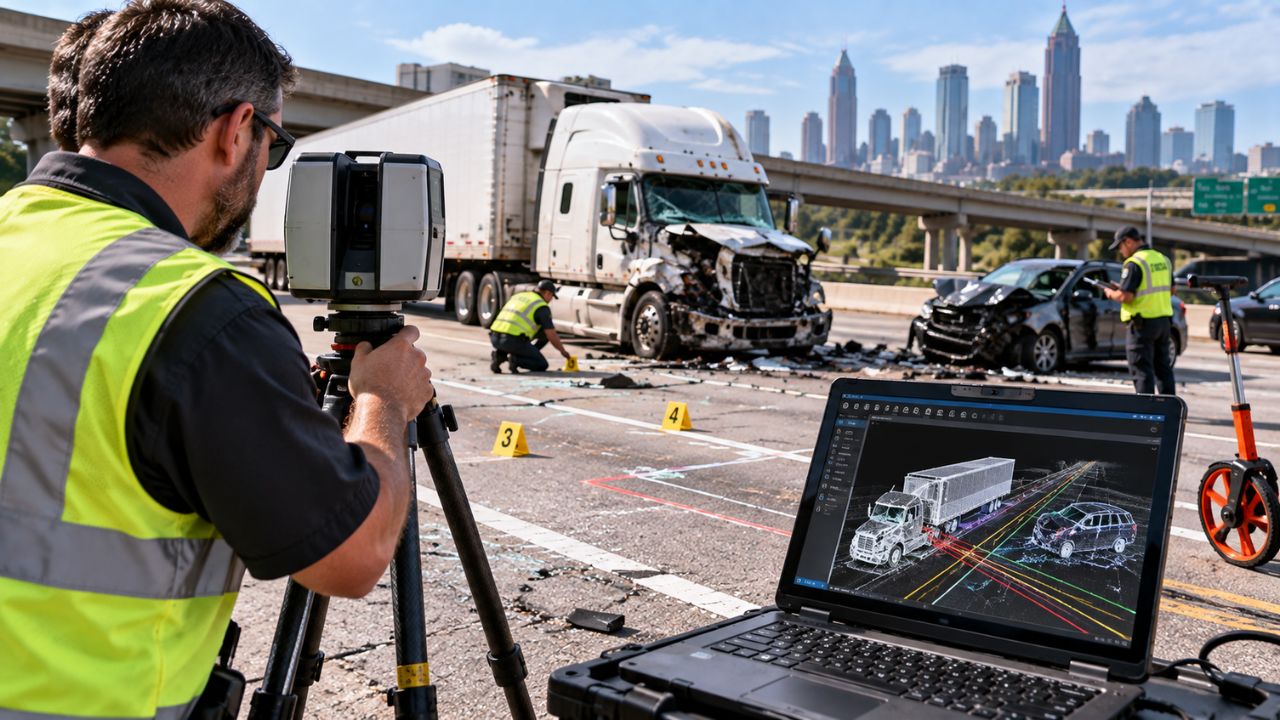
When a loaded semi-truck collides with a passenger vehicle, the physical evidence at the scene tells a story that most drivers never learn to read. That is where truck accident reconstruction Atlanta teams step in. They convert skid marks, wreckage, and digital data into a clear, provable account of what actually happened on the road.
This process is often the difference between a denied claim and a fair settlement. Below, we walk through how reconstruction actually works, why speed matters, and what evidence carries the most weight in a Georgia truck crash case.
What Is Crash Scene Reconstruction?
Crash reconstruction is a scientific method of recreating a collision using physical evidence, vehicle data, and roadway conditions. Investigators combine accident reconstruction engineering with real-world trucking regulations to answer one question: who caused the crash, and why.
For truck wrecks specifically, this goes far beyond a standard car accident report. Commercial trucks carry onboard computers, weigh thousands of pounds more than a sedan, and operate under federal safety rules that ordinary drivers never have to follow. That added complexity is exactly why truck accident reconstruction Atlanta cases demand a specialized approach from the first phone call.
Why the First 24 Hours Matter
Evidence at a truck crash scene degrades fast. Skid marks fade, debris gets cleared from the highway, and trucking companies routinely erase or overwrite onboard data on a set schedule.
Why Spoliation Letters Matter
This is where Why spoliation letters matter becomes a central legal tool. A spoliation letter is a formal notice sent to the trucking company and its insurer, demanding that all evidence, including dash cam footage, maintenance logs, and driver records, be preserved before it can be lost or destroyed. Without one, a carrier may legally dispose of records within days of the crash, along with the proof a victim needs.
The Role of Black Box and ECM Data
Almost every commercial truck built in the last two decades carries an event data recorder, commonly called a black box. This device captures speed, braking, throttle position, and engine RPM in the seconds before impact.
Pulling this information requires access to the truck’s electronic control module (ECM) data. It can confirm whether the driver braked in time, was speeding, or had cruise control engaged at the moment of the crash. In many disputed liability cases, this single data point settles the argument outright.
Because carriers control this equipment, requesting it early is a core part of any truck accident reconstruction Atlanta investigation. Delay gives the trucking company more room to argue that the data was lost through normal system cycling.
Hours-of-Service Records and Driver Fatigue
Federal Motor Carrier Safety Administration rules limit how long a commercial driver can be behind the wheel. Under current FMCSA hours-of-service regulations, property-carrying drivers may drive up to 11 hours after 10 consecutive hours off duty, cannot operate past the 14th hour of a shift, must take a 30-minute break after 8 hours of driving, and are capped at 60 hours over 7 days or 70 hours over 8 days.
Electronic logging devices track this automatically, which means hours-of-service violations usually show up clearly once the logs are pulled. A driver who was awake for 16 hours straight or who falsified a log to hide a missed break provides a reconstruction team with strong evidence of fatigue-related negligence.
Reading the Physical Scene: Skid Marks, Debris, and Damage
Digital data tells part of the story, but the physical scene still matters. Investigators use skid-mark analysis, gouge marks in the pavement, the final resting positions of both vehicles, and the pattern of debris to calculate speed, braking distance, and the point of impact.
Damage analysis, sometimes called crush analysis, estimates the force of a collision based on how deeply a vehicle’s frame was compressed. Combined with black box output, this paints a highly accurate picture of exactly how fast each vehicle was moving and where they collided.
Weather, road surface, and visibility at the time of the crash matter too. A wet highway or a poorly lit stretch of road can shift how fault is assigned, especially when a carrier argues that conditions, not driver behavior, caused the wreck.
A Local Example: The I-285 Corridor
Atlanta’s I-285 perimeter is one of the busiest freight corridors in the Southeast, carrying a constant flow of tractor-trailers alongside daily commuter traffic. The mix of merging lanes, dense congestion, and long hauls makes this stretch a frequent site for rear-end collisions, jackknife incidents, and underride crashes.
A truck accident reconstruction team working on an I-285 case typically pulls together traffic camera footage, weather data, and the truck’s telematics to establish exactly how a routine commute turned into a catastrophic wreck. Corridor-specific knowledge, such as lane geometry and known congestion points, often shapes how quickly liability can be established.
How Fault and Compensation Are Calculated
Georgia generally gives victims 2 years from the date of the crash to file a personal injury lawsuit, making early evidence collection essential. However, shorter deadlines may apply in certain cases, such as when filing an ante litem notice against a government entity.
Commercial trucking cases often involve insurance policies with $750,000 limits, so insurers work aggressively to shift blame. Reconstruction can also reveal whether the trucking company, maintenance provider, or cargo loaders share liability, helping identify all available sources of compensation.
Why You Need a Truck-Specific Legal Team
General auto accident experience does not automatically translate to trucking cases. FMCSA regulations, ECM data extraction, and multi-party liability, involving the driver, the carrier, and sometimes a maintenance contractor, require a legal team that works these cases regularly.
If your crash happened outside the city core, a Cobb County truck accident attorney on our team can apply this same reconstruction process to local roadways and interchanges, ensuring the investigation reflects exactly where and how the crash occurred.
Put a Reconstruction Team on Your Side
Every hour after a truck crash matters. Evidence disappears, logs get overwritten, and insurance adjusters start building their defense immediately. Our team moves just as fast, sending spoliation letters, securing black box data, and reviewing FMCSA logs before the trail goes cold.
If you were hurt in a commercial truck crash anywhere in the Atlanta area, reach out today for a free case review. Let our Atlanta truck accident reconstruction team turn the evidence at the scene into the proof you need to fully recover.
Frequently Asked Questions
How long does truck accident reconstruction take?
Timelines vary by case complexity, but early evidence preservation, like spoliation letters and ECM downloads, typically takes days to weeks to complete properly.
Can I still recover damages if I was partly at fault?
Yes. Georgia’s comparative negligence rule allows recovery as long as you are found less than 50% at fault, though your award is reduced accordingly.
What happens if the trucking company deletes the black box data?
Deleting evidence after a spoliation letter is sent can lead to serious legal consequences for the carrier, including sanctions that may help the victim’s case.
How soon should I contact a lawyer after a truck accident?
As soon as possible. Evidence such as skid marks and electronic logs can disappear within days, and Georgia’s filing deadline begins immediately.
Do all commercial trucks have black box data recorders?
Most trucks manufactured in the last two decades carry event data recorders, though access to that data usually requires a formal legal request.