
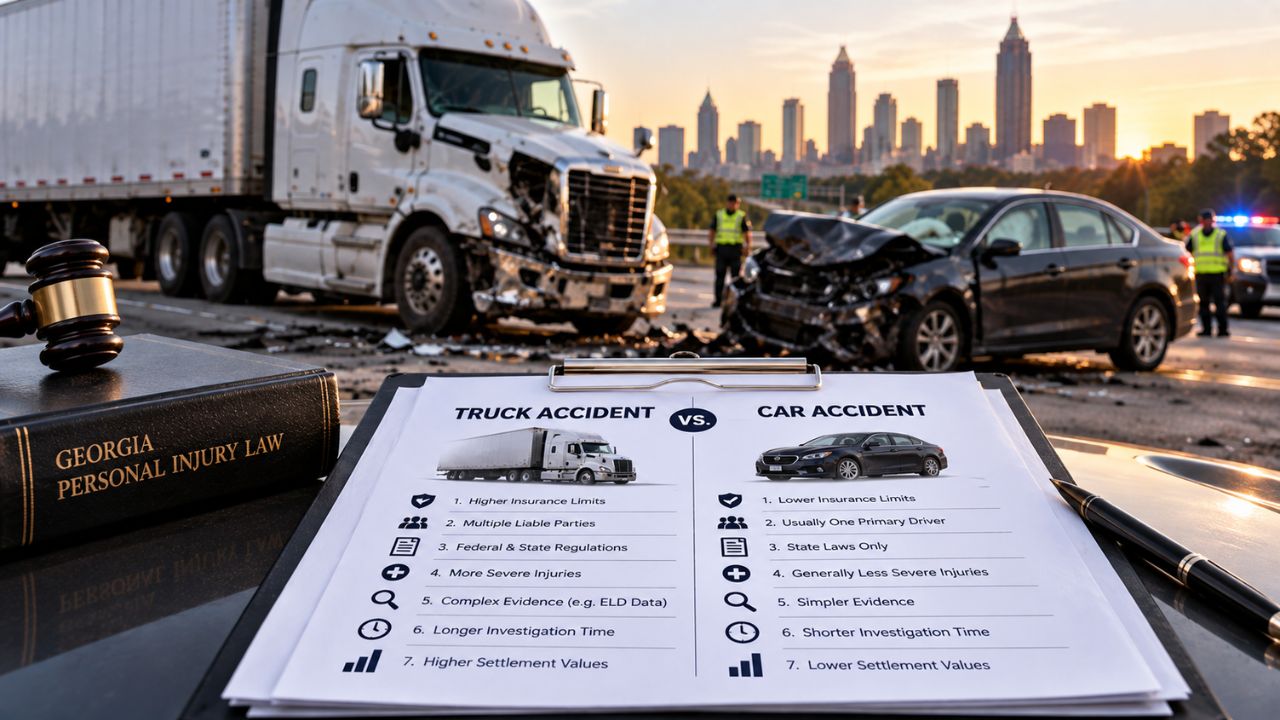
If you have been hurt in a wreck involving a big rig, you already sense that something feels different from an ordinary fender bender. The difference between a truck accident and a car accident claim shows up almost immediately in the paperwork, the insurance policies, and the number of parties who get pulled into your case. A rear-end collision between two sedans and a jackknifed tractor-trailer on I-285 may both start with a police report, but they rarely end the same way. Understanding these differences early can protect your right to fair compensation.
1. More Parties Can Be Held Liable
In a typical car accident, liability usually rests with one driver. A commercial truck crash can involve the driver, the trucking company, a leasing company, a cargo loader, or even a parts manufacturer. Each party may carry separate insurance, adding negotiation layers that most car accident claims never see.
This is one of the clearest markers of the truck accident vs. car accident claim difference, and it is why early legal guidance matters. A DeKalb County truck accident lawyer typically starts by identifying every company that could share responsibility before evidence and witnesses disappear.
Untangling these relationships often means requesting lease agreements, dispatch records, and maintenance contracts, none of which come into play in an ordinary two-car crash. The more parties involved, the more insurance adjusters are woring the case, each looking to shift blame elsewhere before a claim is even filed.
2. Federal Trucking Regulations Add a Layer of Law
Car accidents are governed almost entirely by Georgia traffic law. Truck accidents fall under the Federal Motor Carrier Safety Administration (FMCSA), whose rules cover driver qualification, vehicle maintenance, drug testing, and record keeping. Georgia’s negligence law still applies, but FMCSA violations often become central proof in a truck case.
Hours-of-Service Rules Matter
FMCSA’s hours-of-service rules cap driving at 11 hours within a 14-hour on-duty window, followed by 10 consecutive hours off duty, with a mandatory 30-minute break after 8 hours behind the wheel. Drivers also face a 60-hour limit over 7 days or 70 hours over 8 days, after which a 34-hour restart is required. A driver who exceeds these limits has not just broken a company policy. They have violated federal law, and that violation can support a negligence claim.
FMCSA also requires driver qualification files, background checks, and drug and alcohol testing for commercial operators. When one of these requirements gets skipped, it often points to a pattern of cutting corners rather than a single moment of carelessness, which can matter a great deal when a claim is evaluated or goes before a jury.
3. Commercial Insurance Minimums Are Far Higher
Georgia requires drivers to carry 25/50/25 in liability coverage: $25,000 per person, $50,000 per accident, and $25,000 for property damage. Commercial carriers hauling general freight must carry at least $750,000 in liability coverage under FMCSA rules, and hazardous material hauliers may need up to $5,000,000.
That gap changes how insurers approach settlement, and it is a major piece of the truck accident vs. car accident claim difference that surprises many injured drivers. A car accident claim can stall out quickly once a $25,000 policy is exhausted. A properly documented truck accident claim has far more room to fully account for medical bills, lost income, and long-term care.
4. Evidence Preservation Moves on a Faster Clock
Car accident evidence usually means a police report, photos, and witness statements. Truck accident claims add the driver’s electronic logging device records, maintenance logs, and the truck’s black box data, formally called the electronic control module. This data can show speed, braking, and engine performance in the seconds before impact.
Spoliation Letters Protect the Evidence
Because trucking companies routinely overwrite or discard electronic records on a rolling schedule, attorneys send a spoliation letter almost immediately after a crash. This letter formally demands that the carrier preserve black box data, dispatch records, and driver logs before they are lost. Our Gumprecht Law Firm’s truck accident team sends these letters within days, not weeks, because that window closes fast.
A truck’s electronic control module can record vehicle speed, throttle position, brake application, and hard-braking events in the moments before a collision. Once that data is gone, it cannot be recreated, which is why a delayed call to an attorney can quietly weaken an otherwise strong truck accident claim.
5. Comparative Negligence Gets More Complicated
Georgia follows a modified comparative negligence rule under O.C.G.A. § 51-12-33. You can recover compensation if you are less than 50% at fault, but your award is reduced by your share of responsibility.
Truck accidents often involve multiple potentially liable parties, including the driver, the trucking company, the maintenance provider, or the cargo loader, making fault more complex than in typical car crashes. Insurance companies may try to assign more blame to the injured person to reduce or deny compensation. Strong evidence and thorough documentation can help protect your claim.
6. The Filing Deadline Is the Same, But Time Still Works Against You Sooner
Georgia’s statute of limitations gives injured people two years from the date of the crash to file a personal injury lawsuit under O.C.G.A. § 9-3-33, and this deadline applies to both car and truck accident claims. However, shorter deadlines may apply in some cases, including ante litem notice requirements for claims against government defendants.
The real difference is practical, not legal. Trucking companies and their insurers often begin building a defense within hours of a crash. At the same time, key electronic evidence can disappear in weeks, long before that two-year deadline ever becomes a concern.
7. Certain Georgia Highways Make Truck Claims More Common
Truck accident claims are especially common on busy highways like Interstate 285, where heavy commercial trucks share the road with daily commuters. Tight merges and major interchanges with Interstate 75, Interstate 85, and Interstate 20 increase the risk of multi-vehicle crashes.
These accidents often involve complex liability and comparative negligence issues. Strong evidence, including traffic camera footage, incident reports, and the truck’s onboard data, is crucial because cleanup efforts can quickly remove or alter important crash evidence.
Get Help Understanding Your Claim
Whether you were hurt by a distracted commuter or a fatigued long-haul driver, Georgia law treats your case differently depending on which one it was. The truck accident vs. car accident claim difference touches everything from the parties involved to the evidence that can vanish within days.
If you are searching for the best car accident attorney in Atlanta, Georgia, or you need a team that already knows how to handle a commercial trucking case, we are ready to help. We move quickly on evidence, we track every deadline, and we keep you informed at each stage of your claim. Reach out today for a free, no-obligation review of your claim.
Frequently Asked Questions
How long do I have to file a truck accident claim in Georgia?
Under O.C.G.A. § 9-3-33, most car and truck accident claims must be filed within two years. Claims against government entities may require earlier compliance with strict ante litem notice deadlines.
What is a spoliation letter, and why does it matter?
A spoliation letter demands that a trucking company preserve black box data, driver logs, and maintenance records before routine deletion erases key evidence.
Can I still recover damages if I was partly at fault?
Yes. Georgia’s comparative negligence rule allows recovery as long as you are less than 50% at fault, with your award reduced by your share of fault.
Why do truck accidents involve more insurance coverage than car accidents?
FMCSA rules require commercial carriers to hold at least $750,000 in liability coverage, far above Georgia’s 25/50/25 minimum required for passenger vehicles.
Why are so many truck accidents reported on I-285?
I-285 carries heavy commercial freight traffic through tight merges and complex interchanges, conditions long linked to serious multi-vehicle crashes in Georgia.